B
BrainBOK
PricingStudy GuideFAQ
DashboardITTO ExplorerQuizFlashcardsExamsStudy Guide
Guide Index
  • Introduction
  • Project
  • Project Management
  • The PMBOK Guide
  • Program, Portfolio, and Operations
  • Project Stakeholders
  • Role and Responsibilities of the Project Manager
  • Project Management Data and Information
  • Project Environment
  • Enterprise Environmental Factors
  • Organizational Process Assets
  • Management Elements
  • Governance Framework
  • Organizational Structure Types
  • Project Management Office (PMO)
  • Project Influences
  • Development Approach and Life Cycle
  • Project Phase and Life Cycle
  • Development Approach
  • Predictive (Waterfall) Development Approach
  • Adaptive (Agile) Development Approach
  • Hybrid Development Approach
  • Project Management Processes
  • Tailoring Project Management Processes
  • Pre-Initiating: How Projects Are Initiated
  • Initiating Process Group
  • Planning Process Group
  • Executing Process Group
  • Monitoring and Controlling Process Group
  • Closing Process Group
  • Project Management Processes
  • Leadership
  • PMI Talent Triangle
  • The Powers of the Project Manager
  • Management vs Leadership
  • Leadership Styles
  • Situational Leadership
  • Servant Leadership
  • Organizational Theories
  • Delegation
  • Vision and Mission Statement
  • Interpersonal and Team Skills
  • Conflict Management
  • Diversity and Inclusion
  • Emotional Intelligence or EQ
  • Meeting Management Techniques
  • Negotiation
  • Tuckman Ladder
  • Dreyfus Model of Skill Acquisition
  • Models, Methods, and Artifacts
  • Project Management Models
  • Project Management Methods
  • Project Management Artifacts
  • BrainBOK PMP and CAPM Study Guide
  • Copyright Notice
  • Disclaimer - BrainBOK PMP Guide
  • PMI Code of Ethics and Professional Conduct
  • Project Management Glossary
  • The Project Manager Mindset: Key to PMP and CAPM Exam Success
PM Fundamentals

Introduction

Project

Definition, characteristics, examples, triggers, and success criteria of a Project

Definition

A project is a temporary endeavor undertaken to create a unique product, service, or result.

If you have ever organized a birthday party you've managed a project!

Characteristics

  • Project is a temporary endeavor, i.e. it has a definite beginning and end
  • Projects drive change; in other words, projects are how businesses implement change
  • Projects enable business value creation
  • Projects are the link between business strategy and execution
  • Deliverables of a project can be any one or a combination of the following:
  • Product, e.g. a building, a machine, a software
  • Service, e.g. a business function
  • Result, e.g. an R&D report, a recommendation report
  • Project is closed when:
  • Objectives are met, OR
  • Project is terminated for reasons such as:
  • Objectives cannot be met
  • Need for the project no longer exists
  • Project runs out of budget

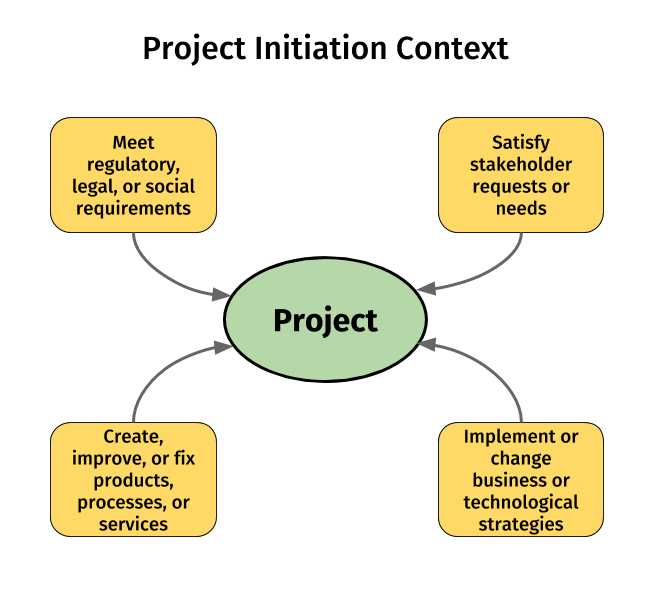
Project Initiation Context

Projects are initiated for four primary reasons:

  1. Meet regulatory, legal. or social requirements
  2. Satisfy stakeholder requests or needs
  3. Create, improve, or fix product, processes, or services
  4. Implement or change business or technological strategies
Examples

Example of a project include:

  • Construction of a building
  • Organizing a birthday party
  • Development of a website
  • Set up of a call center
  • Project management certification

Benefits of Projects

Projects help organizations in two primary ways:

  1. Create business value
  2. Drive organizational change

Definition of Project Success

Traditionally, project success was measured in terms of time, cost, scope, and quality. The more modern view calls for also measuring the extent to which the project objectives are met.

The definition of project success has been further refined in PMBOK® Guide, 7th Ed as:

Value is the ultimate indicator of project success.

It is possible for a project to be successful from a scope/schedule/budget viewpoint, and to be unsuccessful from a business viewpoint. This can occur when there is a change in the business needs or the market environment before the project is completed.

Exercises

  1. Give an example of each trigger listed above.
  2. Which of the following is/are candidate(s) for a Project?
    • Construction of a building
    • Business process re-engineering
    • Helpdesk
    • Development of a new smartphone
    • Manufacturing of cars
    • Development of a new web application
    • IT Datacenter setup
    • IT Datacenter operations
PreviousIntroductionNextProject Management

On This Page

DefinitionCharacteristicsProject Initiation ContextExamplesBenefits of ProjectsDefinition of Project SuccessExercises