B
BrainBOK
PricingStudy GuideFAQ
DashboardITTO ExplorerQuizFlashcardsExamsStudy Guide
Guide Index
  • Project Management Business Documents
  • Lessons Learned Management Techniques
  • Knowledge vs Information
  • Explicit vs Tacit Knowledge
  • The Triple Constraints
  • Configuration Management System
  • Complexity Models
  • Ambiguity vs Uncertainty
  • PMI-isms
  • Scope Creep
  • Scope Creep vs Gold Plating
  • Gold Plating
  • Product Scope vs Project Scope
  • Requirements vs Scope - What's the Difference?
  • Requirement Types
  • Focus Groups vs Facilitated Workshops
  • Progressive Elaboration
  • Critical Path Method (CPM)
  • Crashing vs Fast Tracking
  • Rolling Wave Planning
  • Estimation in Project Management
  • Earned Value Management
  • Earned Schedule
  • Cost Budget and Reserves
  • Direct Costs vs Indirect Costs
  • Project Selection Methods
  • Accuracy vs Precision
  • Control Charts
  • Rule of Seven in Control Charts
  • Common Cause vs Special Cause Variations
  • Quality vs Grade
  • Product Quality vs Project Quality
  • Attribute Sampling vs Variable Sampling
  • Verification vs Validation
  • Roles and Responsibilities
  • Resource Calendar vs Resource Histogram
  • Resource Leveling vs Resource Smoothing
  • Situational Leadership (SLII)
  • Pondy's Conflict Model
  • Myers-Briggs Type Indicator (MBTI)
  • OSCAR Coaching and Mentoring Model
  • Fist of Five
  • Communication Channels
  • Osmotic Communication
  • Risk Management Terms
  • Risk Response Strategies
  • Risk vs Issue
  • Expected Monetary Value (EMV)
  • Sensitivity Analysis and Tornado Diagram
  • Contract Types
  • Personas
  • Stakeholder Classification Models
  • Non-Functional Requirements in Agile
  • Lean vs Six Sigma
  • Impediments, Obstacles, and Blockers
  • Situational Questions
Study Notes

Resource

Ken Blanchard's Situational Leadership II Model

An overview of Ken Blanchard's Situational Leadership II Model and its relevance in project management.

Ken Blanchard's situational leadership model focuses on adapting leadership styles to meet the needs of individual team members based on their level of competence and commitment.

Competence refers to a team member's level of knowledge, skills, and experience related to a particular task or responsibility. Competence can range from low, where the team member is new to the task and lacks experience, to high, where the team member is very experienced and knowledgeable.

Commitment refers to a team member's level of motivation and engagement related to a particular task or responsibility. Commitment can range from low, where the team member lacks motivation or is disengaged, to high, where the team member is highly motivated and fully engaged.

The model is based on the idea that different situations require different leadership styles, and that effective leaders are able to adjust their style to fit the needs of the situation and the team member.

It maps four leadership styles - directing, coaching, supporting, and delegating - to four competence and commitment levels of the team members as shown in the image below.
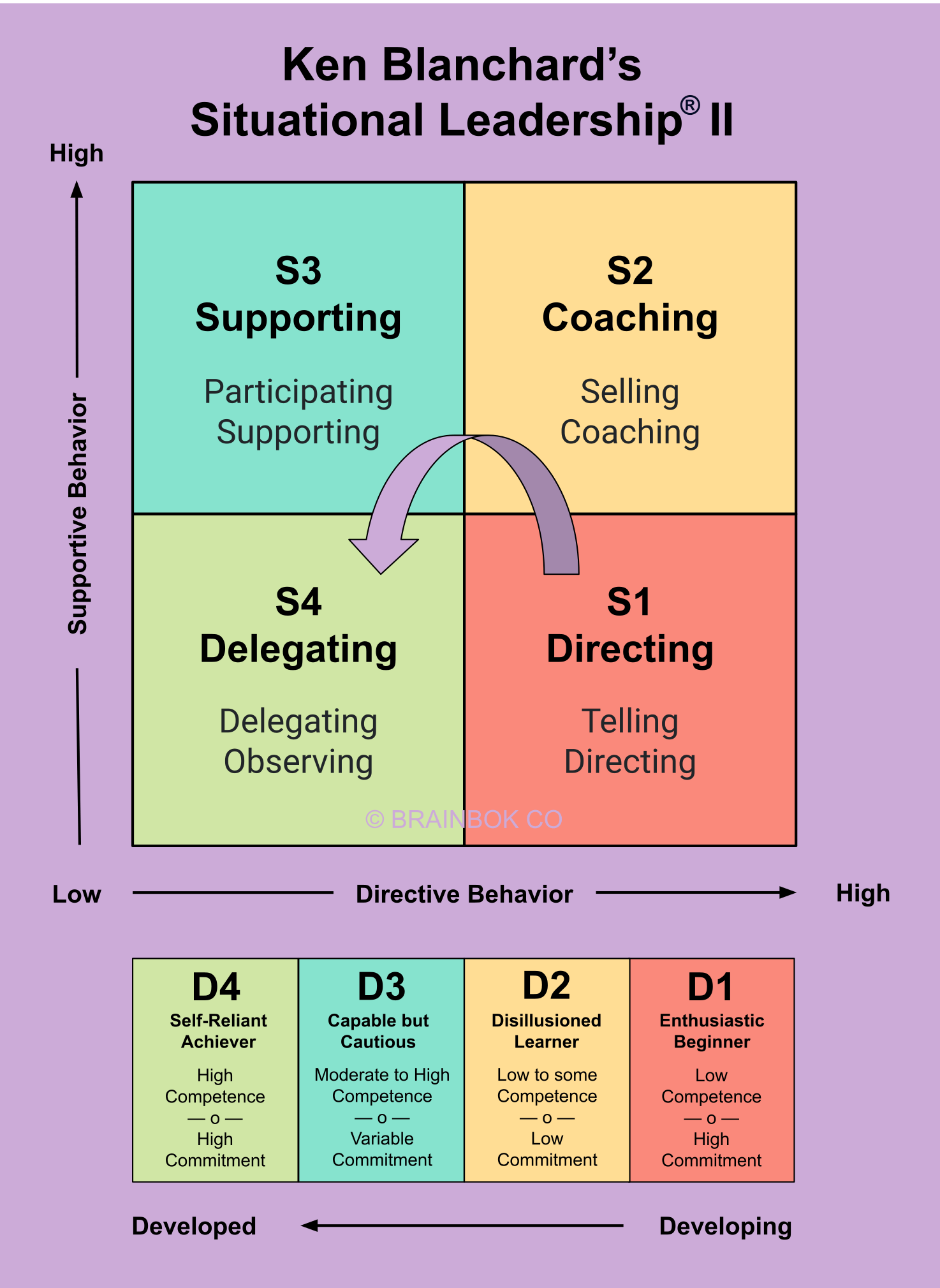
Ken Blanchard's Situational Leadership II Model

The key takeaway is that effective leadership involves adapting one's style to the competence and commitment levels of team members. Leaders should provide more direction and support to those with lower competence and commitment and gradually reduce directiveness and support while increasing delegation as team members become more competent and self-reliant.

Related Topics

  • Dreyfus Model of Skill Acquisition — understand team member competence levels
  • OSCAR Coaching and Mentoring Model — a complementary coaching framework
  • Leadership Styles — overview of all leadership styles including directing, coaching, supporting, and delegating

References

  • Management of Organizational Behavior, 10th Ed by Hersey, Blanchard, Johnson
PreviousResource Leveling vs Resource SmoothingNextPondy's 5 Stages of Organizational Conflict — PMP Study Guide

On This Page

Related TopicsReferences