Stakeholder
Stakeholder Classification Models — Power/Interest, Salience, Stakeholder Cube
Learn how to classify stakeholders using the Power/Interest Grid, Salience Model, and Stakeholder Cube for PMP stakeholder analysis and engagement planning.
Stakeholder Analysis
Stakeholder analysis is a technique used to identify the stakeholders, and their interest, experience and influence on the project.
Why is Stakeholder Classification important
Large projects may have hundreds or even thousands of stakeholders. Projects have limited time, and resources. Therefore, the amount of effort spent on stakeholder management and engagement needs to be prioritized. But what criteria do we use to classify the stakeholders? How do project managers determine which stakeholders have the biggest impact or influence on the project and deserve the most attention? How do project managers prioritize their attention to competing stakeholders?
These are exactly the problems that the stakeholder classification models address. It is important to prioritize the stakeholders to ensure efficient use of effort to communicate and manage their expectations.
- Prioritization:
- Focus resources on stakeholders who need more attention.
- Ensure critical stakeholders are managed closely.
- Tailored Communication:
- Develop effective communication strategies for different stakeholder groups.
- Ensure the right information reaches the right stakeholders at the right time.
- Risk Management:
- Identify stakeholders who may pose risks.
- Proactively mitigate potential risks.
- Stakeholder Engagement:
- Create appropriate engagement strategies.
- Foster and maintain stakeholder support.
- Expectation Management:
- Align stakeholder expectations with project goals.
- Enhance stakeholder satisfaction by addressing their concerns.
Stakeholder Classification Models
Several models are available to classify stakeholders according to the their power, interest, impact, influence, urgency and other parameters.
Grid-based Models
The grid-based models are useful for small projects or projects with simple stakeholder relationships. The three common grid-based models are:
- Power/Interest grid
- Power/Influence grid
- Impact/Influence grid
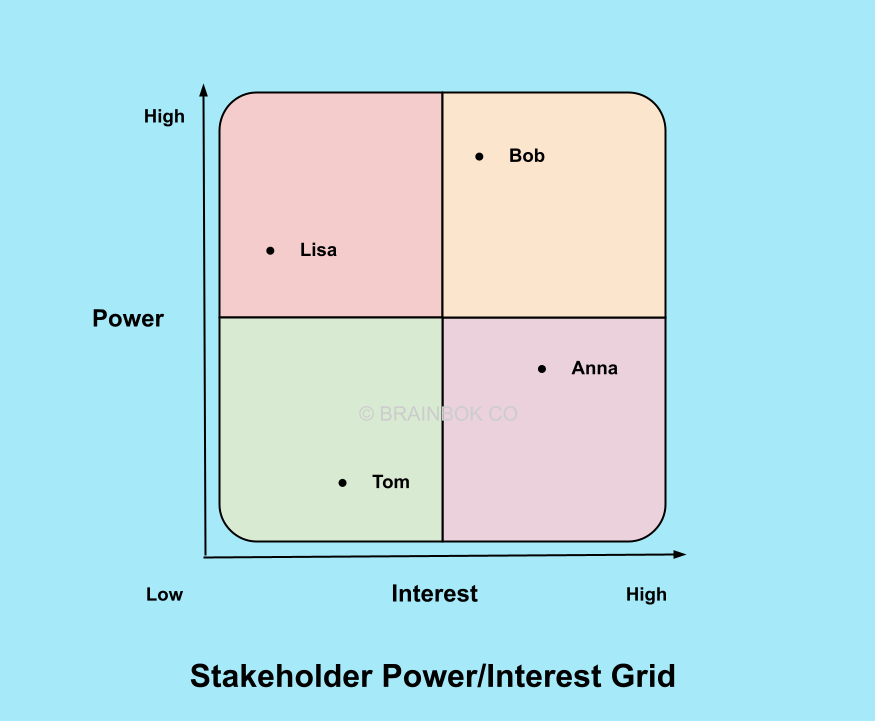
Classifying stakeholders helps prioritize engagement efforts. Here's a general guideline:
- High Power, High Interest: Manage closely, collaborate, and involve in decision-making.
- High Power, Low Interest: Keep satisfied, inform proactively, and address concerns.
- Low Power, High Interest: Educate, listen to feedback, and address anxieties.
- Low Power, Low Interest: Monitor, provide basic updates, and communicate minimally.
Salience Model
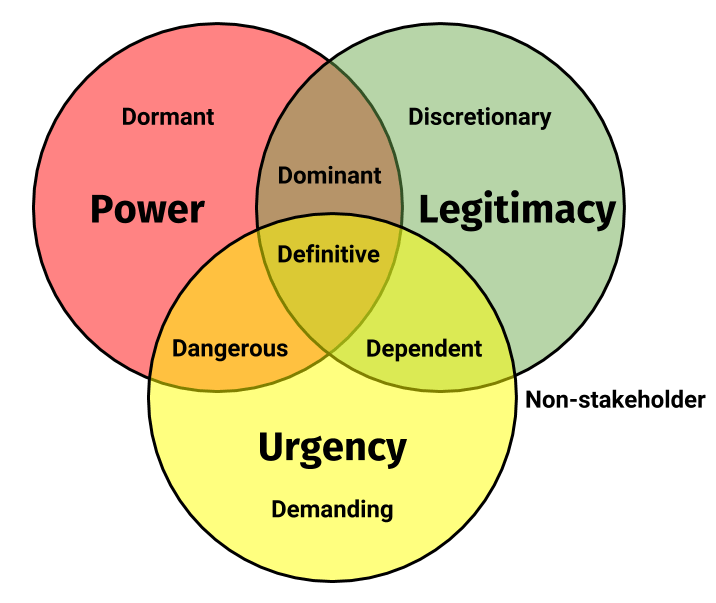
The Salience Model classifies stakeholders based on the following three attributes:
- Power: authority and influence in the organization and on the project outcomes
- Legitimacy: their involvement is appropriate (morally, legally etc.)
- Urgency: calls for immediate attention, or pressing need
The Salience Model is graphically depicted as a Venn Diagram as shown below. The three circles represent Power, Legitimacy and Urgency. It has eight regions marked on the diagram each representing different types of stakeholders on the project. Different strategies are used to manage each of the eight categories of stakeholders identified using this model.
Salience Model helps to identify "Who or What Really Counts". The model emphasizes the need to pay attention to stakeholders in a timely manner. The Salience Model has advantages over the two-dimensional grid models such as the Power-Interest Grid, as the Salience Model adds the vital dimensions of legitimacy and urgency. It provides the project managers a systematic approach to managing stakeholder relationships.
Refer to Deep Fried Brain Project's blog post The Salience Model for Stakeholder Classification for an in-depth explanation of the Salience Model.
Stakeholder Cube
The three dimensions of a stakeholder cube are:
- Power
- Interest
- Attitude
Mosaic Project's post For Stakeholders, 2×2 Is Not Enough! provides a very good explanation of the Stakeholder Cube.
Directions of Influence
Stakeholders can be classified based on their influence on the project or the project team. This method of classification includes:
- Upward: Senior management, sponsor, steering committee
- Downward: Project team members and experts working on the project
- Outward: Suppliers, government agencies, regulators, public and end users
- Sideward: Peers such as other project managers, and functional managers
Prioritization
Prioritizing stakeholders may be necessary when:
- Large number of stakeholders are involved
- Stakeholders are changing rapidly
- Relationship with stakeholders is complex