Resource
OSCAR Coaching and Mentoring Model
An overview of the OSCAR Coaching and Mentoring Model and its relevance in project management
Overview
The OSCAR coaching and mentoring model emphasizes the importance of collaboration and partnership between the coach or mentor and the mentee, and it encourages the mentee to take ownership of their goals and actions. The coach or mentor's role is to facilitate the mentee's exploration and decision-making process, and to provide guidance and support as needed. It was developed by Karen Whittleworth and Andrew Gilbert.
The OSCAR model can be used in project management to help project managers provide effective support and guidance to their team members. By using this model, project managers can help team members to develop their skills and abilities, overcome challenges, and achieve their goals. The model is particularly useful for project managers seeking to adopt a coaching style.
Five Elements of the OSCAR Model
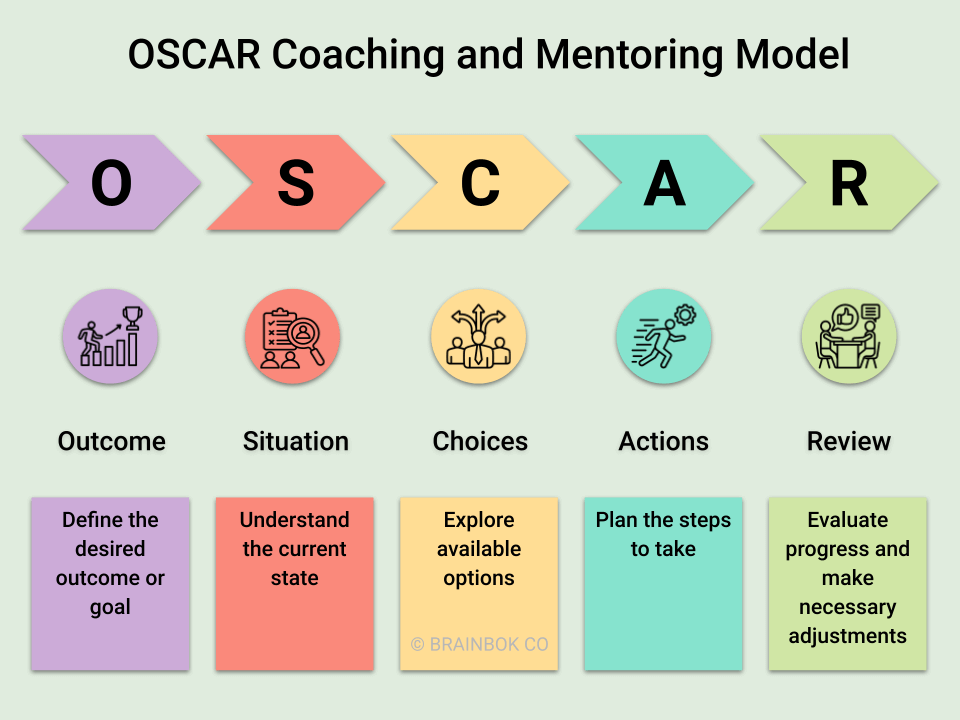
Credit: Icons created by Dewi Sari - Flaticon
OSCAR is an acronym for the five steps of the model viz. Outcome, where goals are defined; Situation, which involves understanding the current state; Choices, exploring available options; Actions, planning the steps to take; and Review, evaluating progress and making necessary adjustments.
- Outcome: The desired outcome or goal of the coaching or mentoring relationship should be clearly defined and agreed upon by both parties.
- Situation: The project manager should assess the situation and consider factors such as the team member's strengths, weaknesses, and challenges, as well as external factors that may be impacting their performance or wellbeing.
- Choices (and/or Consequences): The project manager should help the team member explore and evaluate different options and choices for achieving their desired outcome.
- Actions: The project manager should help the team member develop an action plan for implementing their chosen options and achieving their desired outcome.
- Review: The project manager should continually review and evaluate the team member's progress, providing feedback and making adjustments as needed to ensure they stay on track towards achieving their desired outcome.