Quality
Rule of Seven in Control Charts — Run of Seven Explained
Learn what the Rule of Seven means in control charts, why seven points on one side of the mean matter, and how this concept appears in PMP exam questions.
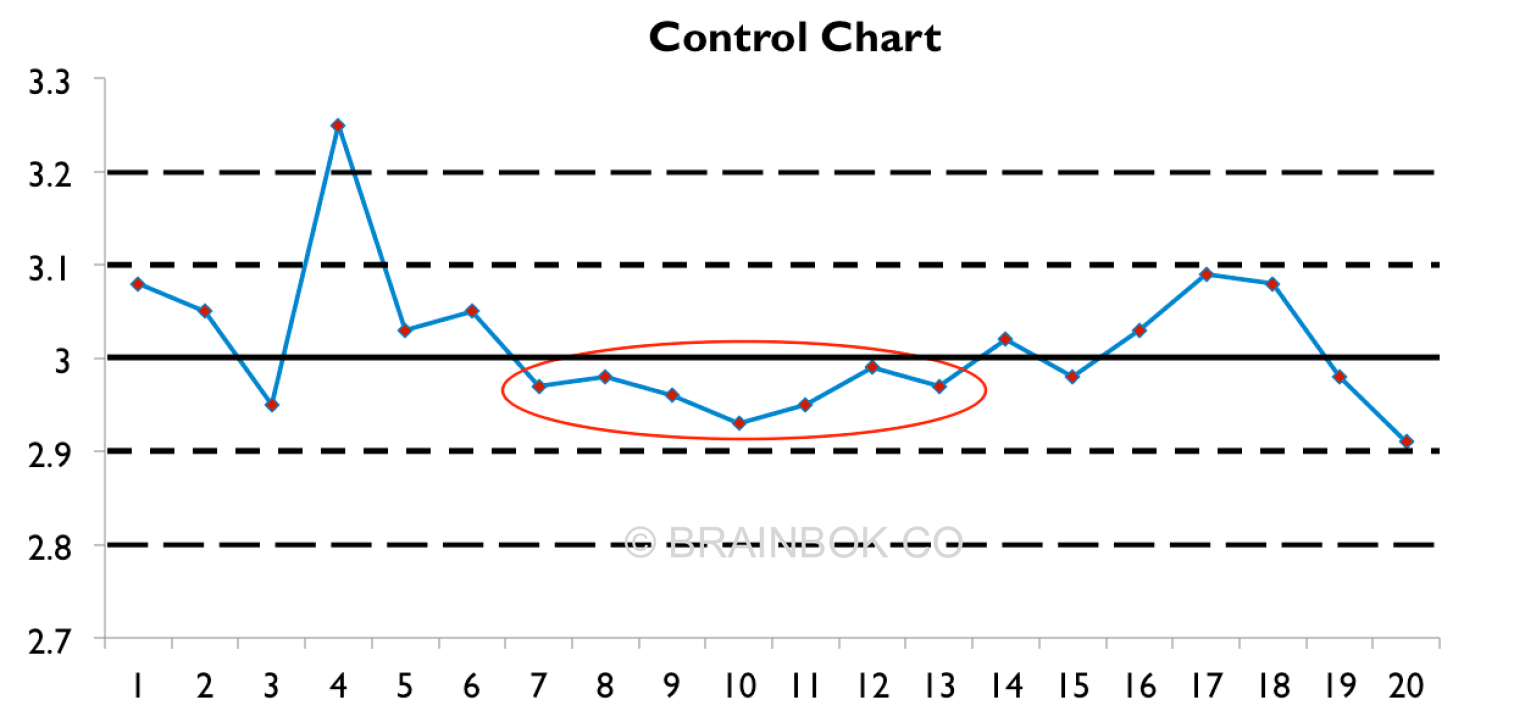
The rule of seven states that if seven or more consecutive measurements fall on one side of the mean that there's an assignable cause that needs investigation.
Key Points
- Rule of seven is a rule of thumb or heuristic.
- On a control chart, when seven consecutive data points fall on the same side of the mean, either above or below, the process is said to be out of control and in need of adjustment.
- All the seven points may be within the control limits.
- Such a situation is not considered normal (or common) and warrants an investigation.
- It does not necessarily mean that a corrective action is needed, but it does need to be investigated to find an assignable cause.
- It also doesn't imply that the frequency at which a process becomes out of control is acceptable (or not acceptable).
Rule of Seven on a Control Chart
Refer to the figure below for an example of seven data points below the mean on a control chart.
Sample Question 1
A process is designed to produce high precision cylindrical rods. The control limits for the rod diameter are 11.90 mm to 12.10 mm. During a quality inspection, 20 random samples were selected from the production floor, and the following measurements were observed (all values are in mm):
12.09, 11.90, 12.06, 12.08, 12.10, 12.10, 12.09, 12.07, 12.00, 11.99, 12.02, 12.01, 12.07, 12.03, 12.10, 11.95, 12.05, 11.98, 11.97, 11.95
Which of the following statements is true about the process?
A. The process is in control as all measurements are within the control limits.
B. The process is in control.
C. The process is in out of control and in need of adjustment.
D. The process is in out of control and in need of inspection.
Sample Question 2
Using the example from Exercise 1, if the data points are the following, what can be said about the process (select from the same four options given above)?
12.09, 11.90, 12.06, 12.08, 12.10, 12.10, 12.09, 12.07, 12.00, 11.99, 12.02, 12.01, 11.99, 11.93, 11.90, 11.95, 11.98, 11.97, 11.95, 12.05
Solutions
- The mean of the process is the central value, which is 12.00 mm (mean of 11.90 mm and 12.10 mm). All 20 points are within the control limits. In no case do we have seven points falling on the same side of the mean. There's a case where six points fall above the mean, but the seventh point is right on the mean (tricky indeed). Therefore, the process is in control.
- In this case, we indeed have seven data points on the same side of the mean - 11.99, 11.93, 11.90, 11.95, 11.98, 11.97, 11.95. The process is considered out of control and warrants an inspection (not adjustment). Inspection may or may not call for an adjustment.